
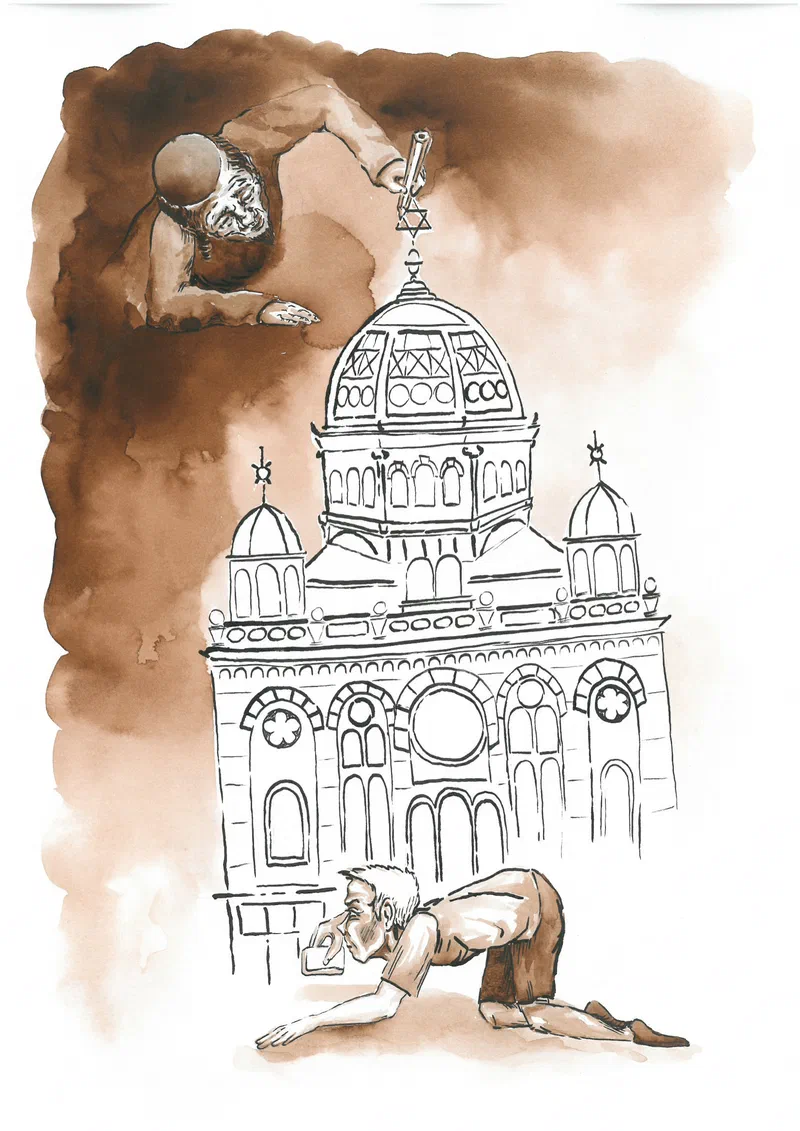
The LARGEST synagogue in Bohemia
Jewish people were the largest and most distinctive minority in Teplice at the turn of the 19th and 20th centuries. Their synagogue formed part of the town for a mere 56 years.
Luck favoured the Jews in Teplice in the second half of the nineteenth century – they were in no danger in the multicultural environment of the European spa town – in fact the opposite was the case. Well developing industry needed capable traders and bankers – and many a Jewish person managed to fill these roles. In the period when imposing buildings were springing up in Teplice like mushrooms, Jews accounted for nearly 10% of the population. However, most people had no desire to segregate them in any way – most Jews in Teplice were religiously liberal and fully integrated within what was then the elite. Not only factory owners, but also members of the municipal board, doctors and lawyers came from within their ranks. Considering the fact that all of them also spoke German, many people regarded them as Germans.
However, the Jews did differ in at least one way – religion. Because this religious community was growing stronger both in significance and in numbers, they wanted to demonstrate its social significance. So, when a synagogue designed by the prominent (and Jewish) Vienna architect Wilhelm Stiassny was consecrated in 1882 on the so-called Jewish Hillock (Židovský vršek), on the corner of Chelčického and Lípová streets today, the superiors of the community were rightly proud. The largest synagogue in Bohemia was a comparable counterpart and a worthy rival to the Lutheran Church of Bartholomew the Apostle that was built a few hundred metres away, virtually at the same time.
The building served its purpose for a mere 56 years. During the night of 14th –15th March 1939 the synagogue was burnt down by the Nazis. A memorial by architect Milan Míšek today stands a short way from its former walls.
It is not possible to ascertain from the results of an official census how many Jews are currently in Teplice. According to reports from the Jewish community, however, their number hovers at around one hundred, i.e. at a level of no more than 0.9% of the town’s entire population.